
Start tonight with three exercises: a 5-minute active-listening check-in, a soft “I” statement practice, and a brief stress-reducing conversation before either of you brings up anything hard. These work faster than vague promises to “communicate better” because they create small, repeatable moments of practice instead of relying on willpower during a fight.
Here’s why each one earns a spot on this short list:
- Active-listening check-in — one partner talks for 3 minutes uninterrupted while the other reflects back what they heard, which builds the habit of feeling understood before problem-solving starts.
- Stress-reducing conversation — 10 minutes talking about anything outside the relationship (work, a friend, a frustrating commute) lowers physiological tension so you’re not walking into deeper talks already on edge.
- “I” statement practice — swapping “You never help” for “I feel overwhelmed when I handle this alone” cuts down defensiveness almost instantly.
Try this script tonight: “Can I have 5 minutes to just talk, and you just listen? I’ll do the same for you after.” Then say one sentence that starts with “I feel ___ when ___.”
Pro Tip: Do the active-listening check-in before dinner, not after. Tired brains at 9 p.m. are far more likely to turn a check-in into a rehash of an old argument.
Key Takeaways
Communication exercises work best when they’re practiced daily in calm moments, paired with clear conflict-safety rules, and escalated to professional support when patterns like contempt or stonewalling persist.
| Point | Details |
|---|---|
| Start small tonight | Try a 5-minute active-listening check-in and one “I” statement before tackling bigger issues. |
| Practice on a schedule | Anchor exercises to an existing daily habit, like right after dinner, so they don’t quietly disappear. |
| Use soft start-ups | Open hard conversations with “I feel ___ when ___” instead of blame to avoid triggering defensiveness. |
| Know your timeout length | Take at least 20 minutes apart when flooded before returning to a hard conversation. |
| Get matched when needed | Myaligntherapy pairs couples with a therapist suited to their specific issue, often within 24 hours. |
Table of Contents
- A Week-1 Plan for Practicing Communication Exercises for Couples
- What Are the Best Couples Communication Techniques to Practice?
- How Do You Make These Exercises a Lasting Habit?
- Why Do Communication Exercises Sometimes Fail?
- When Do Couples Need Professional Help Instead of Self-Guided Exercises?
- Ready-to-Copy Templates for Communication Exercises for Couples
- What Surprises Most Couples About This Kind of Practice
- A Faster Way to Get Matched With the Right Couples Therapist
- Sources
A Week-1 Plan for Practicing Communication Exercises for Couples
Communication exercises for couples work best when they’re scheduled, not left to spontaneous good intentions. The first week is about proving to yourselves that five or ten minutes a day is sustainable, not about fixing every pattern you’ve built over years together.
Here’s a simple structure to follow for seven days.
- Days 1 and 2: Stress-reducing check-ins only. Spend 10 minutes each evening talking about your day, with no relationship topics allowed. This isn’t stalling. It rebuilds the habit of talking to each other for connection instead of logistics.
- Days 3 and 4: Add the active-listening exercise. One partner talks for 3 minutes about something mildly annoying (not a partner-related complaint), the other reflects it back without offering solutions.
- Day 5: Introduce one “I” statement. Pick something small and low-stakes to practice on, like “I feel rushed when we’re running late,” rather than saving it for your biggest grievance.
- Day 6: Rest. Skipping a day on purpose keeps the exercises from feeling like a chore.
- Day 7: Hold a 20-minute weekly check-in, structured loosely around three questions: What went well between us this week? What felt hard? What’s one thing we want more of next week?
Set two ground rules before you start: phones stay in another room, and neither partner interrupts until the other says “I’m done.” Couples who agree on concrete, shared rules, rather than vague goals like “listen better,” tend to follow through more consistently, according to a survey on relationship communication. A rule like “we put phones in the kitchen during check-ins” is something you can actually catch yourselves breaking. “Be more present” isn’t.
Pick two or three exercises to rotate through the week rather than trying all of them at once. Trying to overhaul every conversation habit simultaneously is the fastest way to abandon the whole plan by Wednesday.
Pro Tip: If day 7 feels awkward the first time, that’s normal. Practicing skills during calm moments, not just during conflict, is what makes them available when you actually need them, according to research on relationship communication patterns.
What Are the Best Couples Communication Techniques to Practice?
The exercises below split into two categories: ones that build connection during calm moments, and ones that keep conflict safe when things get tense. Both matter. Couples who only practice during peace time often freeze the moment a real disagreement starts, and couples who only focus on conflict management never build the reserve of goodwill that makes repair possible.
Connection-building exercises
1. Validation practice
Goal: confirm your partner’s feelings make sense, even if you disagree with their conclusion.
- Partner A shares a feeling about a recent event (2 minutes).
- Partner B responds only with validation: “That makes sense that you’d feel that way, given what happened.”
- No advice, no counterargument, no “but.”
- Switch roles.
Timing: 5 minutes total, 2 to 3 times a week. Common mistake: validating too fast, which can feel dismissive. Slow down and repeat back specifics before you validate. Variation: validate a feeling you don’t personally share, like frustration over something you found minor. That’s the harder, more valuable version.
2. Active listening / reflective listening
Goal: prove you heard the content and the emotion behind it, not just the words.
- Speaker talks for 2 to 3 minutes on one topic.
- Listener reflects back: “What I heard is ___. Did I get that right?”
- Speaker corrects or confirms.
- Swap roles.
Timing: 10 minutes, ideally 3 to 4 times a week. Common mistake: listening for your turn to respond instead of listening to understand. Variation: add an emotion guess, as in “It sounds like that left you feeling dismissed.”
3. “I” statements

Goal: state a need or feeling without assigning blame.
Script: “I feel ___ when ___, and what I need is ___.”
- Practice on a low-stakes topic first (chores, scheduling).
- Avoid “I feel like you always…” (that’s a disguised accusation, not a feeling).
- Practice out loud before using it in a real conversation.
Timing: once a day for the first week, then as needed. Common mistake: using “I feel” as a prefix to a criticism (“I feel like you’re lazy”). Variation: write the statement down first if speaking it feels too raw.
4. Love Maps
Goal: stay current on your partner’s inner world, not just the version of them you knew years ago.
- Ask one open-ended question a day: “What’s stressing you out this week that I might not know about?” or “What’s something you’re looking forward to?”
- Answer fully, resist the urge to shorten it for time.
- Keep a running mental (or written) list of what you learn.
Timing: 5 minutes daily. Common mistake: sticking to surface-level facts (favorite food, birthday) instead of current emotional terrain. Variation: turn it into a weekly game, guessing what your partner’s answer would be before they give it.
5. Appreciation game
Goal: counteract the brain’s bias toward noticing problems over positives.
- Each partner names one specific thing the other did that week that they appreciated.
- Be concrete: “I appreciated that you handled the plumber call” beats “You’re great.”
- No follow-up criticism tacked on.
Timing: once daily or at minimum during the weekly check-in. Common mistake: making it generic or perfunctory. Variation: write appreciations on sticky notes for a week instead of saying them aloud.
6. Turn-toward bids
Goal: notice and respond to small requests for connection, which is what actually predicts long-term stability more than grand romantic gestures.
- Notice when your partner makes a “bid,” like commenting on something they saw, sighing about their day, or reaching for your hand.
- Turn toward it: respond, ask a follow-up, make eye contact.
- Track for one day how often you turn toward versus away.
Timing: ongoing awareness, reviewed weekly. Repair attempts and consistent turning-toward responses are strongly linked to relationship stability over time, according to a review of couple-intervention research. Common mistake: treating bids as interruptions to whatever you’re doing. Variation: keep score for a week, then compare notes together, without judgment.
7. Storytelling exercise
Goal: rebuild the “we” narrative of your relationship, which fades under daily stress.
- Take turns telling the story of how you met, a hard time you got through together, or a favorite shared memory.
- Let your partner add details you may have forgotten.
- Do this once a month, especially during dry spells.
Timing: 15 to 20 minutes, monthly. Common mistake: rushing through it like a chore. Variation: record it, write it down, or turn it into a small ritual around an anniversary.
Conflict-safety exercises
8. Soft start-up

Goal: open a hard conversation without triggering immediate defensiveness.
Script: “I feel ___ about ___, and I need ___,” instead of “You always…” or “Why do you never…”
The way a conversation begins predicts, with striking consistency, how it ends. The Gottman Institute’s research on relationship communication found that a softened start dramatically improves the odds the conversation stays productive rather than spiraling into blame. Common mistake: softening the words but keeping a harsh tone or body language. Variation: write the opening line down before saying it out loud if you tend to escalate quickly when talking live.
9. Repair attempts
Goal: de-escalate mid-argument before things spiral.
- Agree in advance on a phrase or gesture that means “I need us to pause and reconnect,” like “Can we start over?” or a light touch on the arm.
- Use it the moment tension rises, not after things have already boiled over.
- Practice saying it during calm moments so it feels natural mid-conflict.
Timing: as needed, but rehearse monthly. Common mistake: waiting too long to use it. Variation: build a small, personal catalog of repair gestures unique to your relationship (inside jokes, a specific phrase) rather than relying only on generic scripts, since tailored repair attempts tend to land better than one-size-fits-all lines.
10. Timeout / physiological self-soothing
Goal: stop a conversation before flooding takes over, and return once both partners can think clearly again.
- Agree on a signal (“I need a timeout”) that either partner can call without it being seen as walking away.
- Separate for at least 20 minutes; do something calming, not something that rehearses the argument in your head.
- Return and check in: “Are we okay to keep talking, or do we need more time?”
Timing: as needed. Common mistake: taking a 5-minute break, which usually isn’t long enough for heart rate and stress hormones to settle.
11. Mirroring
Goal: slow down a heated exchange by requiring exact repetition before response.
- Speaker says one sentence.
- Listener repeats it back verbatim before responding.
- Continue, one sentence at a time, until tension drops.
Timing: use when a conversation starts to speed up or escalate. Common mistake: paraphrasing instead of mirroring exactly, which reintroduces interpretation and argument. Variation: use it only for the first 5 minutes of a hard talk, then switch to normal conversation once things feel steady.
12. Role reversal
Goal: build empathy by arguing your partner’s position instead of your own.
- Each partner briefly argues the other’s side of a disagreement.
- Notice what feels hardest to say convincingly, that’s often where the real misunderstanding lives.
Timing: occasional, when a recurring argument feels stuck. Common mistake: using it sarcastically instead of genuinely. Variation: swap roles again afterward and discuss what surprised you.
13. Tech rules
Goal: protect check-ins and hard conversations from constant low-grade interruption.
- Agree on phone-free windows (meals, check-ins, the first 20 minutes after work).
- Put phones in another room, not just face-down on the table.
- Revisit the rule monthly since life circumstances change.
Timing: ongoing. Common mistake: treating this as optional instead of a firm shared rule. Variation: extend the rule to a full evening once a week if you’re comfortable.
How Do You Make These Exercises a Lasting Habit?
Communication exercises for couples fail most often not because the technique is wrong, but because there’s no cue attached to it. A habit needs three parts: a cue, a routine, and a reward. Without a fixed trigger, “we should check in more” quietly dies somewhere around week two.

Attach your check-in to something that already happens every day. After dinner, before brushing teeth, during the drive home. The cue matters more than the exercise itself; a 5-minute active-listening check-in tied to “right after we sit down for dinner” will outlast the same exercise floating with no anchor.
The reward doesn’t need to be elaborate. Feeling heard is the reward. But it helps to notice it out loud: “That felt good, thanks for listening.” Naming the payoff reinforces the loop.
Tracking doesn’t require an app or a spreadsheet. Simple, low-effort options work better because they don’t become one more thing to manage:
- A one-line log. Jot a sentence after each check-in: what topic, how it went, one word for how you felt.
- A felt-heard scale. Rate 1 to 5 after a check-in: “How heard did you feel just now?” Compare notes over a few weeks.
- A completion rate. Simply mark an X on a calendar for each day you did a micro-practice. Visual streaks build motivation on their own.
If motivation drops, the fix usually isn’t “try harder.” It’s shrinking the ask. If daily check-ins feel like too much, cut to three times a week. If 10 minutes feels like too much time, cut to 5. Run it as a two-week experiment rather than a permanent commitment, which lowers the pressure enough that most couples actually follow through.
Pro Tip: If one partner keeps “forgetting” or resisting, let them set the terms for the first two sessions, choosing the topic, the length, even the day. Control over the format reduces the sense of being pushed into something, and it often turns quiet resistance into real participation.
Why Do Communication Exercises Sometimes Fail?
Most failed attempts trace back to one of three things: flooding, contempt, or mismatched expectations about effort.
Flooding is what happens when a partner’s heart rate spikes during conflict, usually somewhere in the range that research on couples during conflict associates with a sharp drop in the capacity for constructive communication (research on physiological arousal in couples places this threshold around 100 beats per minute). Once flooded, no exercise works. The fix isn’t a better script, it’s a break of at least 20 minutes to let the nervous system reset, followed by a genuine check-in before resuming, not a silent return to the same fight.
Contempt, criticism, defensiveness, and stonewalling, often called the Four Horsemen in Gottman’s research, each have a specific antidote:
- Criticism → soft start-up and “I” statements instead of global accusations.
- Contempt → building a habit of appreciation to counteract it before it takes root.
- Defensiveness → taking partial responsibility, even for a small piece of the problem.
- Stonewalling → timeout plus reconnection, treating the shutdown as a stress response rather than a personal attack. Gottman’s own research frames stonewalling as largely physiological rather than intentional, which reframes it from “they’re punishing me” to “they’re overwhelmed.”
Mismatched effort shows up when one partner is enthusiastic and the other feels forced. Rather than pushing harder, try a small experiment: two weeks, one exercise, and let the more reluctant partner set the pace. Curiosity (“What would make this feel less like homework?”) works better than pressure every time.
When Do Couples Need Professional Help Instead of Self-Guided Exercises?
Self-guided communication exercises for couples help a genuine number of relationships, but they have limits. Clinical guidance is consistent that certain patterns need more than a script and a weekly check-in, according to Harvard’s research on communication skills.
Watch for these signals that it’s time to bring in a therapist:
- Contempt or criticism shows up as a default tone, not an occasional slip.
- One partner has made threats, or there’s any history of abuse.
- Stonewalling persists even after timeouts and reconnection attempts.
- Old trauma keeps surfacing mid-conversation and derails otherwise calm check-ins.
- One or both partners feel like they’re going through the motions with no real change after weeks of consistent practice.
A therapist offers something self-guided exercises can’t: a trained third party who assesses your specific patterns, coaches you through practice in real time, and mediates repair attempts when things get too heated to navigate alone; for practical exercises and clinical resources, see Mhrc. That’s a meaningfully different experience than reading a script off a page.
Myaligntherapy matches couples with therapists chosen for the specific issue they’re facing, whether that’s a communication breakdown, unresolved trauma, or a life transition putting new pressure on the relationship. Instead of matching by whoever has an open slot, the process pairs you with a therapist suited to your situation, often getting you into a first session within 24 hours.
Ready-to-Copy Templates for Communication Exercises for Couples
Structured, repeatable check-ins are one of the most underused tools in a relationship, according to research on couples therapy worksheets and activities, largely because they build a kind of relational infrastructure that prevents the same arguments from resurfacing week after week.
Copy the templates below into a notes app, or print them and keep them somewhere visible.
| Template | What it includes |
|---|---|
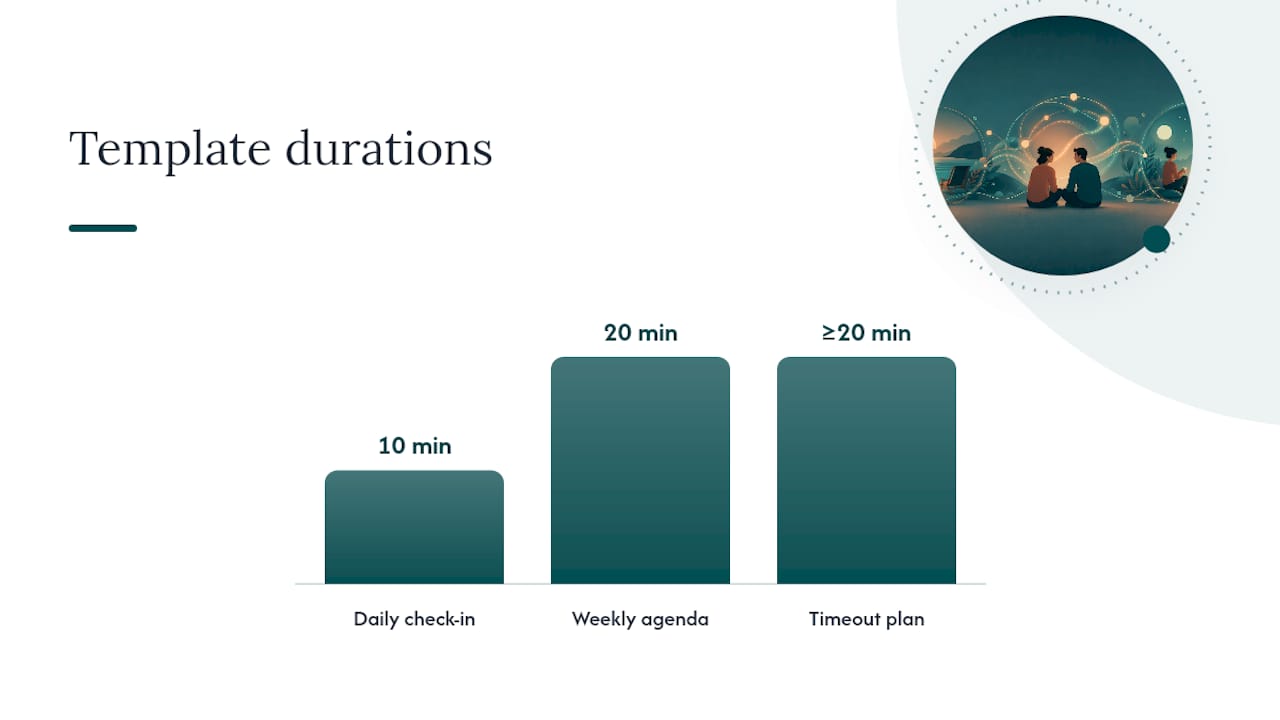
| 10-minute daily check-in | One appreciation, one Love Map question, 3 minutes of active listening each way |
| 20-minute weekly agenda | What went well, what felt hard, one request for next week, one repair attempt review |
| Timeout and reconnect plan | Agreed signal word, minimum 20-minute separation, a return question (“Are we okay to keep talking?”) |
| Soft start-up script | “I feel ___ about ___, and what I need is ___” |
| Repair attempt phrase | A personal phrase or gesture agreed on in advance, used the moment tension rises |
Adjust for your schedule. If evenings are chaotic with kids or shift work, move the daily check-in to a shared commute or a lunch-break call. If either of you struggles to sit still for a full 20-minute weekly agenda, split it into two 10-minute sessions across the week instead of skipping it altogether.
What Surprises Most Couples About This Kind of Practice
The biggest surprise isn’t how hard the exercises are. It’s how uncomfortable it feels to slow down enough to actually listen instead of preparing a rebuttal. Couples expect the resistance to come from conflict. It usually comes from the quiet exercises first, the ones that ask you to just sit with what your partner is saying without fixing it.
Progress rarely looks like a straight line. Expect weeks where you skip check-ins entirely, then come back to them. That’s not failure, it’s the normal shape of behavior change. Combine self-practice with professional support when patterns feel bigger than a script can hold. Both things can be true: you’re doing the work, and you might still need a therapist a couple of times to move through something old.
A Faster Way to Get Matched With the Right Couples Therapist
If you’ve tried the exercises above and you’re still circling the same argument, the gap usually isn’t effort. It’s not having a trained third party to catch the pattern you can’t see from inside it. Myaligntherapy exists for exactly that moment: personalized matching that pairs you with a therapist chosen for the specific issue straining your relationship, not just whoever happens to have an opening.

Most matching services optimize for speed or insurance compatibility and hand you whoever’s available. Myaligntherapy works differently: therapists are matched to the actual issue you’re facing, whether that’s a communication breakdown, a trust rupture, or a life transition putting new strain on the relationship, and most clients start their first session within 24 hours of reaching out. You can see how the therapist-matching process works before you commit to anything, or browse couples-focused therapy services to see the range of specialties available.
If the exercises in this guide felt useful but you’re sensing they’re not enough on their own, that’s worth trusting. Get matched with a couples therapist and see who’s available for your situation.
Sources
- Improve relationship communication – The Gottman Institute
- Physiological studies of couples during conflict (PMC5961625)
- Marriage